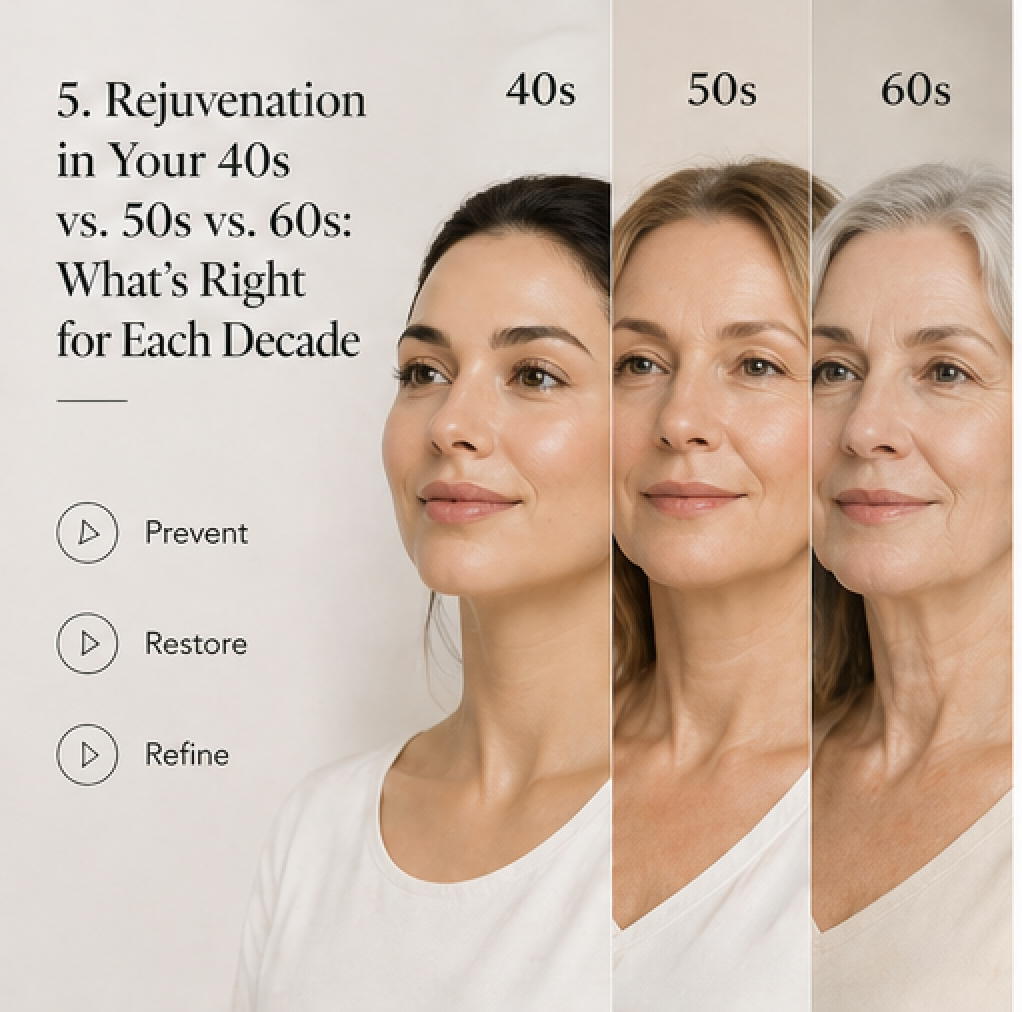
Facial aging is a continuous process, but the changes that occur, and the treatments that address them, differ by decade. Understanding what happens to your face at each stage of life can help you make informed decisions about when and how to pursue facial rejuvenation.
Understanding How the Face Ages
Facial aging involves changes at multiple levels:
- Skin: Loss of collagen and elastin, thinning, texture changes, sun damage accumulation
- Fat: Volume loss in some areas, descent in others
- Muscle: Weakening of facial muscles, repetitive movement creating lines
- Bone: Gradual resorption (loss) of facial bone structure
- Ligaments: Loosening of the ligaments that hold facial structures in place
These changes occur at different rates in different people, influenced by genetics, sun exposure, lifestyle factors, and overall health.
Your 40s: Early Changes and Prevention
What's Happening:
In your 40s, you may notice early volume loss in the cheeks and temples, fine lines becoming more visible (especially around eyes and mouth), early skin laxity, and sun damage becoming more apparent.
Recommended Approaches:
This decade is ideal for preventive measures and early intervention:
- Skincare: Medical-grade skincare with retinoids, antioxidants, and sunscreen
- Neurotoxins (Botox): Address dynamic wrinkles before they become permanent
- Dermal Fillers: Restore early volume loss, particularly in cheeks and under-eyes
- Skin Treatments: Chemical peels, laser treatments, or microneedling to improve texture and tone
- Sun Protection: Critical for preventing further damage
For most patients in their 40s, nonsurgical treatments are sufficient. Surgery is rarely needed unless there are specific concerns or premature aging.
Your 50s: Addressing Visible Changes
What's Happening:
The 50s often bring more noticeable changes including significant volume loss in midface and temples, jowling and loss of jawline definition, deeper nasolabial folds and marionette lines, neck laxity and banding, more pronounced skin texture changes, and eyelid hooding or under-eye bags.
Recommended Approaches:
This decade often marks the transition from purely nonsurgical to considering surgical options:
- Continued Nonsurgical Care: Neurotoxins, fillers, and skin treatments remain important
- Blepharoplasty: Eyelid surgery can dramatically refresh the appearance
- Neck Treatments: Nonsurgical skin tightening or early neck lift
- Facelift Consideration: Many patients begin considering facelift in their late 50s
- Fat Grafting: Can restore volume more permanently than fillers
Research suggests that the "right time" for a facelift depends on individual aging patterns, but many surgeons find that patients who undergo facelift in their late 50s to early 60s achieve excellent, long-lasting results.
Your 60s and Beyond: Comprehensive Rejuvenation
What's Happening:
By the 60s, most patients experience significant skin laxity and sagging, pronounced jowling and neck changes, deeper wrinkles and folds, substantial volume loss, and accumulated sun damage and skin texture changes.
Recommended Approaches:
This decade often calls for more comprehensive intervention:
- Facelift and Neck Lift: Surgical lifting provides the most significant improvement for moderate to severe laxity
- Blepharoplasty: Often combined with facelift for comprehensive rejuvenation
- Fat Grafting: Restores volume and improves skin quality
- Skin Resurfacing: Laser treatments or peels to address texture and pigmentation
- Maintenance Treatments: Continued neurotoxins and fillers to complement surgical results
Long-term studies show that facelift results remain stable for up to 10 years, with high patient satisfaction even 20 years after surgery.
The Importance of Combination Approaches
Regardless of age, the best results often come from combining multiple treatments. Research shows that patients who undergo facelift surgery increasingly use cosmetic injectables afterward—44% of facelift patients receive injectables postoperatively compared to only 18% preoperatively.
This reflects the understanding that comprehensive facial rejuvenation addresses multiple aspects of aging: surgical lifting addresses laxity and sagging, volume restoration (fillers or fat) addresses deflation, skin treatments address texture and tone, and neurotoxins address dynamic wrinkles.
Factors Beyond Age
While age provides a general framework, other factors influence the right approach:
- Genetics: Some people age faster or slower than average
- Sun Exposure: Significant sun damage may accelerate the need for intervention
- Lifestyle: Smoking, stress, and poor nutrition accelerate aging
- Personal Goals: Some patients prefer minimal intervention; others want more dramatic change
- Recovery Tolerance: Surgical procedures require more downtime
The Bottom Line
There's no single "right age" for any procedure. The best approach is individualized based on your specific concerns, anatomy, goals, and lifestyle. Whether you're in your 40s focusing on prevention, your 50s considering your first surgical procedure, or your 60s seeking comprehensive rejuvenation, working with an experienced surgeon can help you develop a plan that's right for you.
Schedule a Consultation
Ready to take the next step in your journey?
To learn more and explore how insurance may help cover your procedure, reach out to our team:
Call or Text: +1 (310) 890-7262
Email: care@drkriya.com
Our team is here to support you every step of the way, from navigating insurance approval to guiding you through recovery with confidence and care.
